A Child's View of Forest School
What is really happening when children play, explore and learn outdoors?
Drawing on observations from Forest School sessions at Milford Pre-School Plus in Hampshire, Forest School leader Sarah Rix explores how regular woodland experiences help children develop practical skills, leadership, confidence, empathy and a lasting connection with the natural world. Through children's own words and actions, she reveals the rich learning that can emerge from time spent outdoors
Outdoor Hub
All Activities
What's New
Inspirations
Art & Creating
mud, clay & sand
pine cones & conkers
leaves, sticks & petals
weaving & wool
wooden discs
campfire craft
sun print
inks, dyes & perfume
pebbles
ice & snow
with tools
Tool use & Traditional Crafts
Tool Guides
Activity Inspirations
weaving
felting
pewter
hammers
knives
secateurs & saws
palm drills & rotary hand drills
fire craft
Fire, Shelters & Bushcraft
fire
knots & cordage
shelters
Outdoor Play
mud kitchen book
mud kitchen case studies
den building
Other outdoor play ideas
Curriculum Outdoors
numeracy
literacy
science
Food Outdoors
foraging
campfire cooking
campfire recipes
Nature
Growing & Gardens
Health & Wellbeing
Festivals & celebrations
Activity Downloads
Product Information
All Events
Courses, Training and Workshops
Forest School Training
Forest School Leader Training (Level 3)
Forest School Assistant Training (Level 2)
Other Forest School Related Training
Outdoor Learning Courses
CPD
Conferences, Shows & Roadshows
Annual/Special Days/Weeks/Months
Festivals, Camps and Residentials
Study visit
All Forest School
A Child's View of Forest School
Benefits of Forest School
Forest School activities & ideas
Forest School articles & blogs
Forest School Day
Forest School guides & books
Forest School history
Forest School kit lists
Forest School principles
Forest School qualifications
Forest School tools
Forest School training
Forest School videos & podcasts
FS research & reports
Key Forest School organisations
Muddy Faces & Forest School
What is Forest School?
Why forests & woods?
All Mud
10 benefits of mud play
Creepy Crawly Café
FREE Making A Mud Kitchen book
International Mud Day
Introduction
Modular Mud Kitchens
More mud books & mud kitchen guides
Mud activity ideas & free downloads
Mud articles
Mud campaign
Mud Champions!
Mud Day resources
Mud Day, mud play & mud kitchens videos
Mud gallery
Mud on Social Media
Mud play tips
Mud reports & research
Muddy case studies
Shop for mud kit
The importance of soil
All Nature connection
Guides: nature play & nature connection
Happy, healthy, thriving
Nature Connection videos & podcasts
Nature connection in the news
Nature connection v nature contact article
Nature Premium
Reasons to be Outside
Research: nature connection / deficit
Useful websites: connecting to nature
All Health & wellbeing
Connecting to nature
Going to the loo & hygiene outside
Hand washing
Health & wellbeing articles
Health & wellbeing books
Health & wellbeing videos
Introduction
Lockdown outdoors articles
Lockdown research & reports
Mental health & being outdoors
Ready for any weather
Research, reports: health, wellbeing
Shop for Health & Wellbeing kit
Sit spots
Useful websites: health, wellbeing
All Learning outdoors
Developing schools outdoors
Home learning resources
Learning outdoors articles
Learning outdoors books
Learning outdoors guides
Learning outdoors reports
Learning outdoors videos
Learning outside research
Learning outside resources
Learning outside useful websites
Remembering Juliet Robertson
Top tips & inspiring quotes
All Methods & approaches
Beach School
Books
Child led play
Evaluation
Forest Bathing aka Shinrin-yoku
Forest School
A Child's View of Forest School
Benefits of Forest School
Forest School activities & ideas
Forest School articles & blogs
Forest School Day
Forest School guides & books
Forest School history
Forest School kit lists
Forest School principles
Forest School qualifications
Forest School tools
Forest School training
Forest School videos & podcasts
FS research & reports
Key Forest School organisations
Muddy Faces & Forest School
What is Forest School?
Why forests & woods?
Funding your outdoor learning
John Muir Award
Reports & research
Signposts to key approaches & organisations
Videos
A Child's View of Forest School
To an outside eye a Forest School session might 'just' look like playing outdoors - all fun and games - some might even ask 'what is the point?'
Outdoor practitioners understand there is so much going on, if you only stop and observe. Sarah Rix of Milford Pre School Plus, Lymington, Hampshire offers some insights into what is really going on...
"Our Forest School activities provide experiences rich in visual, auditory and kinaesthetic learning within each of our activities. Each one is flexible so each child can build their confidence by repetition and develop self-esteem by succeeding, which will in turn encourage that perseverance that builds up resilience, a crucial part of growing up through childhood.
We access Forest School for five mornings over a fortnight, so we are so lucky to observe all the changes through the year and adapt exciting activities and free play opportunities. The children absolutely love their sessions, they are so keen to get on those waterproofs or sun hats ready for a new experience. We share the Forest School area with the school next door, it contains a wide space filled with mighty oaks for rope swings, field maples for climbing, a large wildlife pond for dipping, a fire circle for cooking and reflecting, a construction area for building, travelling and balancing, a shed containing tools and a saw horse, a whittling area and a parachute area for creating.
We hold a family session each term so the children can show their parents all the amazing activities they get up to at Forest School, and I can tell them all about the incredible opportunities for a wide range of learning. The children love to show their parents how they can carry them out too!"
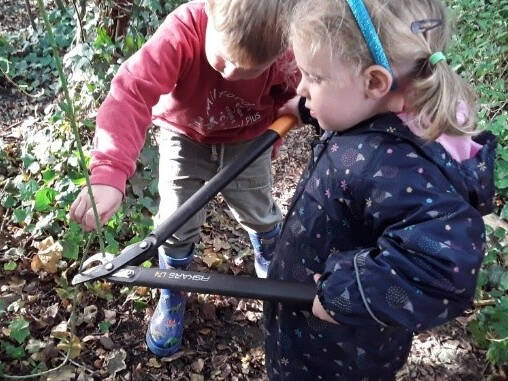
One of the remarkable things about Forest School is using proper tools. It gives our children great confidence, and their self-esteem rises when they can use tools,"just like Daddy!" Because they regularly attend Forest School, they become familiar with the tools we use as part of the maintenance of our woodland site, and to craft wood. We risk assess every session to remind the children how they should use the tools, which in turn ensures they take the care required and understand what could happen if they don't. This makes certain less adult intervention is needed and the children support one another, giving them the leadership.
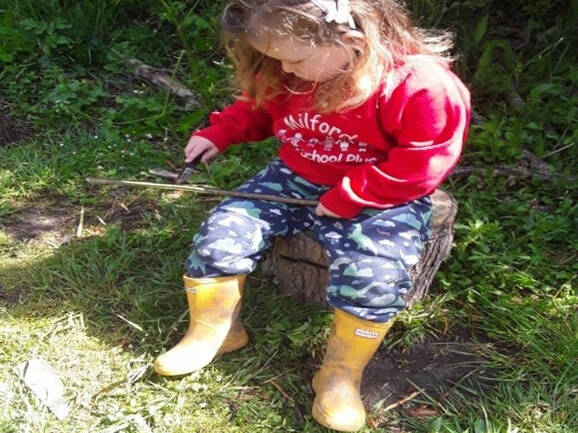
"I can hear the birds singing and they are watching me whittle!"
Our three-and four-years olds whittle independently. They appear to find it such a relaxing and calming activity. Often they are not choosing to create a particular product - they are happy to simply strip the bark of the hazel. The children generally whittle in silence; they are simply listening to the sounds of the woodland as they concentrate.
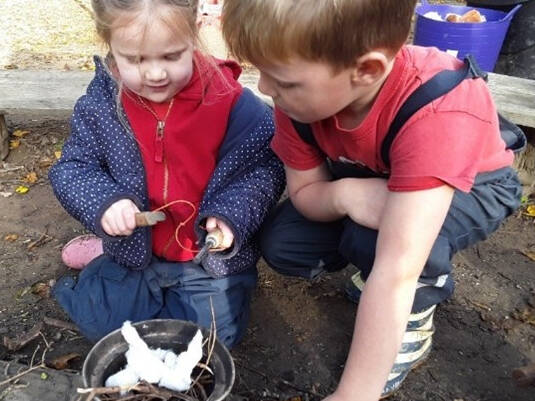
"I know how to light the fire - you hold the Dragons Sneeze here and go whoosh down."
Our children love fire lighting. It's part of our routine to have a fire to cook snacks and the Kelly Kettle for warm water to hand wash. This ensures there are plenty of opportunities for each child to have their turn as they are so keen! Lighting the fire encourages perseverance and determination so the success is immense. A loud cheer rings around the woodland when one of our children succeeds. The children often just come and sit around the fire to watch it grow and cook our food, giving a calming and reflective time, just being. Once the child has success with fire lighting, they offer to help their peers, who always accept the support. They always get down to the same position and take ownership, even giving encouragement as the adult has previously given them. You can see the confidence shining from the lead child as they inspire their peer.
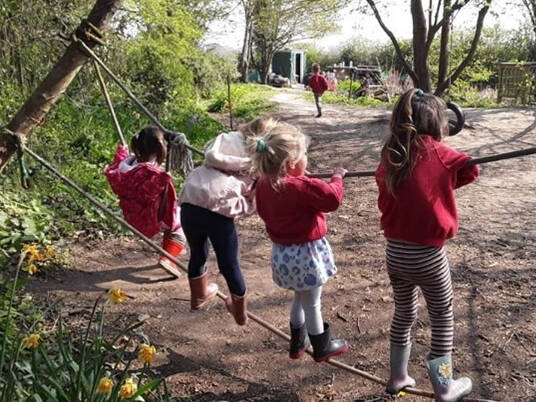
"We all have to go this way, or you will fall off!"
The biggest part of Early Years is providing a rich environment full of personal, social and emotional experiences. As Forest School is holistic, we can support all these activities including teamwork and playing as part of a group. Activities such as rope play, where groups of children play together, is a fitting example of this. Few whole-group experiences occur during indoor play - Forest School offers space and time for the children to play together.
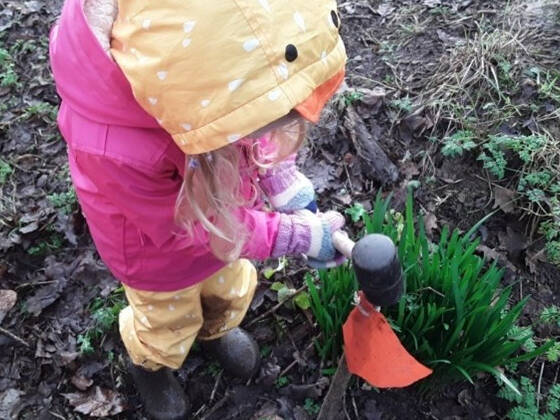
"Look, the bluebells are growing here!"
"We don't want to break them; I can put a hazard flag here."
The children are shown how to look after the fauna and flora at Forest School. We use hazard flags to show everyone where special plants are growing, or if we see a hazard such as foxgloves. The children have also placed them by ant nests or the bird feeders, so no one touches them. This teaches our children empathy for others. They are learning to respect and connect with their natural world. We always say thank you to the wood when we leave and put everything away, to return it to how we found it when we got there.
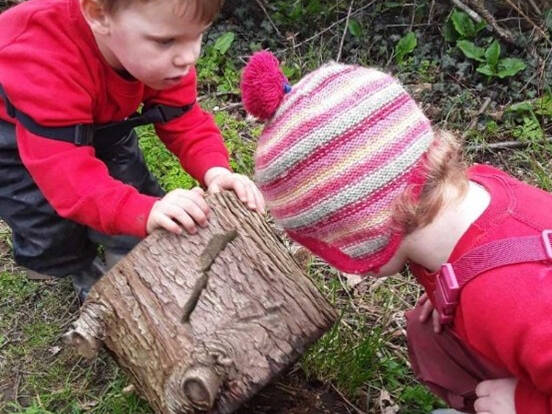
"When we have seen that worm, we have to put his house back or he will die."
Not all our children have the opportunity to own or look after pets. Forest School enables all our children to experience looking after insects or animals. They love to bug hunt and feed the birds, and we always talk about how we respect their feelings by caring for them and handling insects appropriately. The children become so caring, and this then channels across to caring for their peers. We feed our family of sparrows that nest in our boxes and our robins, we talk to the children about how we feed them when they cannot find worms, so they will be hungry.