Nature connection v nature contact article
Is your practice nature connection or nature contact? And does it matter?
Forest School practitioner & trainer Louise Ambrose considers.
From The Outdoor Practitioner magazine, issue 3: Forest School Focus.
Our 2026 catalogue has a focus on the benefits of nature connection, with two brand new, exclusive articles reflecting on the impact of bring outdoors on wellbeing.
Examining children's innate desire to connect to nature, and the special nature of the outdoors with Reasons To Be Outside.
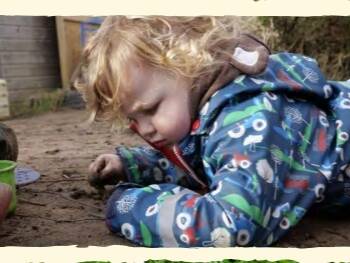
Children are fascinated by small, often unnoticed, living things that thrive in places adults might overlook or dismiss. When we slow down and pay close attention, we experience moments of ‘micro-rest’- brief pauses that calm the mind and allow the parts of our brain responsible for focus to recharge. These gentle effects can be sparked by simple encounters: watching a ladybird, noticing moss growing between paving slabs, or breathing in the natural smell of the earth. These small, achievable experiences are available to all of us and help nurture a deeper connection to nature, supporting a happier, healthier time outdoors.
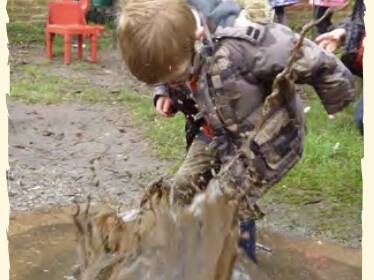
Children are born with an innate desire to connect to nature, drawn to the sights, textures and sensations of the outdoor world. Getting hands-on with the natural world - playing in mud and water, feeling textures, exploring what’s beneath their feet - can spark physical responses that support wellbeing, boost attention and encourage deeper, more meaningful play. Providing regular opportunities for children to spend time outdoors helps to nurture and strengthen this connection. Muddy Faces is dedicated to offering resources that enrich your outdoor spaces, inspire exploration and enable children to connect with nature in an authentic and meaningful way.
Experts tell us that young children should be outside for a minimum of three hours every day (about a quarter of their waking day), all year round. Across generations, we have moved from being ‘earthlings’ to ‘indoorlings’ - perhaps we need reminding of what the outdoors offers that the indoors cannot: the special nature of the outdoors.
Spending time outside in full spectrum natural light improves learning ability and memory as well as mood, through the production of serotonin, often called a ‘feel-good’ hormone.
Outside, the oxygen-rich air wakes up our brains, making us more alert. Children’s bodies learn to respond to changes in temperature; shivering or sweating when necessary to help maintain an optimum body temperature.
The outdoors offers children the space and opportunity to crawl, roll, run, jump, shout and so much more. Physical play helps build the brain for learning and strengthens the muscles needed for active movement, while also laying the foundations for fine motor skills and small, everyday movements.
Feelings of connection to the natural world are developed when we spend time in nature. Children are fascinated by the ‘everyday’ beauty in the world outside the door.
The muscles in our eyes need exercise to develop well. Looking closely at tiny minibeasts one minute, then focussing on a plane in the sky the next provides just this opportunity. With this in mind, why stay indoors? Explore our resources to help create an inspiring outdoor environment for children to enjoy and learn from.
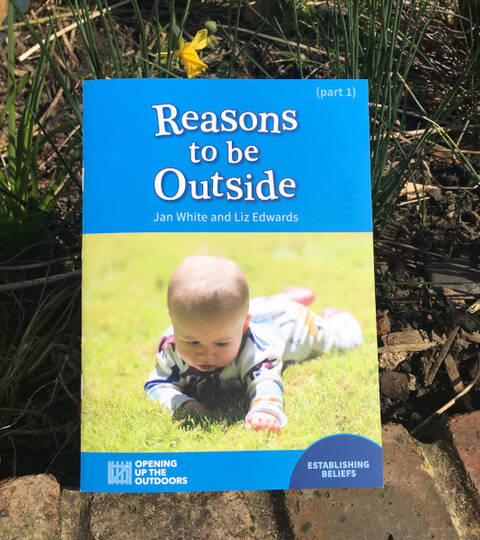
Reasons To Be Outside makes the case that young children must be able to play outside a great deal, every single day, throughout their childhood years.
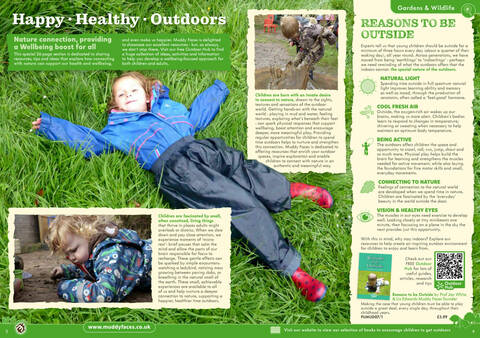
Happy Healthy Outdoors single pages
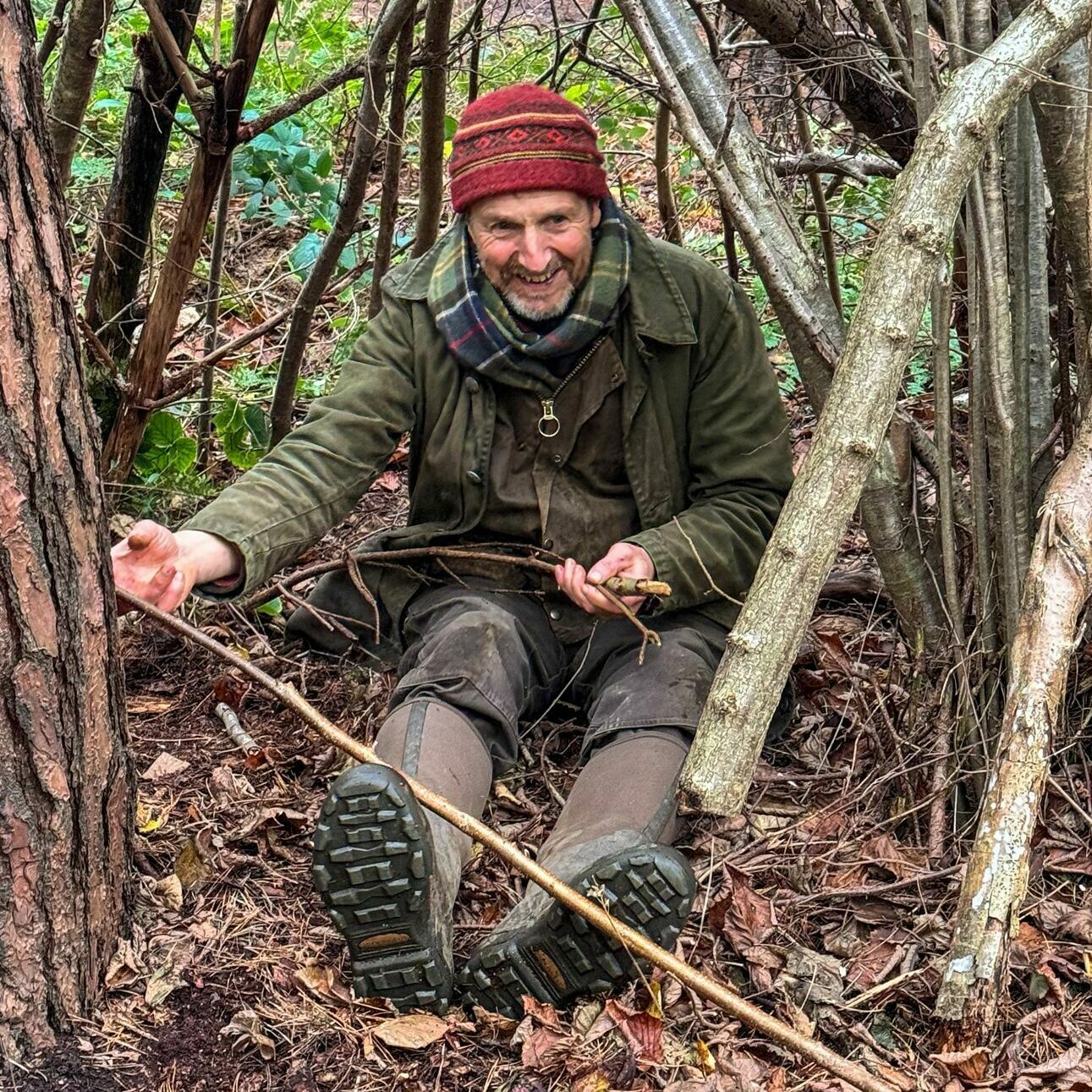
In this article Jon Cree reminds us that we all experience anxiety at some level, indeed, anxiety is important as it helps us respond to risk and challenge in our environment in a measured way. However, we are all aware that if we become too anxious our body/brain system becomes overwhelmed and we no longer function well. Jon goes on to explain that playing outdoors in the presence of supportive adults provides the body with everything that it needs to reduce levels of anxiety and increase wellbeing.
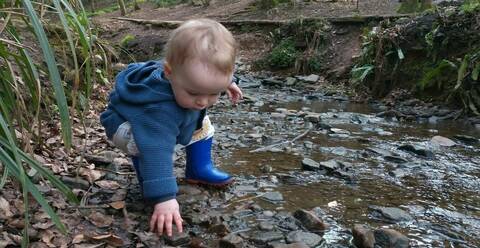
Last week, we spent 20 minutes trying to get welly boots and waterproofs on our 27-month-old granddaughter in preparation for a visit to a park. I felt the tension rise as we chased this gorgeous screaming banshee around the kitchen. She both knows her NO (which I absolutely adore – by the way, these small beings need to know their NO before they can get to a YES!) and at the same time is frustrated by the fact that we are making demands on her to put something on her bare skin and she doesn’t want it.
Recognise this? I bet you do. These transitions from one place to another can be tricky for most of us let alone a two-year-old. So, what is going on here? A combination of things.
For us it is like that boat ride into the dark spooky tunnel at the opening of Willy Wonka’s factory with Gene Wilder screaming at his manic pace to all the families on board – tensions are getting higher and higher and we just want to get off. This behaviour is hard for us as adults, testing our patience and the need to fulfil societies expectations!
For our granddaughter, it is an overwhelming feeling of loss of control. It is not that she won’t go out, she just can’t, due to the cortisol surging through her body, she’s the one getting overwhelmed.
Over my almost 50 years in this profession of nature connection, scenarios such as this seem to be getting more familiar. The great antidote, ironically, is the actual BEING outside.
Today’s young generation is often referred to as ‘the anxious generation.’ Reading Jonathan Haidt’s book of this title, it is clear from all the research that this is linked to the shift from a play-based childhood to a screen-based childhood which started in 1995 (when Gen Z began) and became deeply embedded in 2007/2008 when the iPhone and android smartphones hit the markets.
So what is anxiety? Hopefully you got a feel from my opening paragraph, and all readers will feel it – it is, after all it is an essential emotion that protects us and helps us plan for the future... that is its gift.
However, anxiety becomes an issue is when it impedes our everyday living and is out of control, particularly when we start worrying about the worrying (worry is not an emotion, it is the thinking part of anxiety). Brene Brown described worry as a chain of negative thoughts about bad things that might happen in the future (2021).
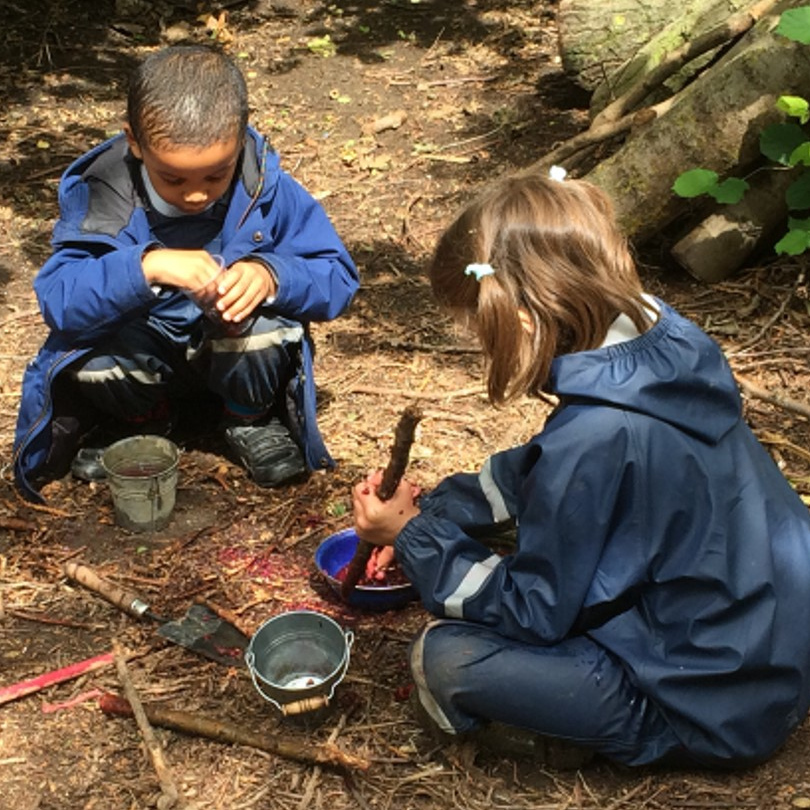
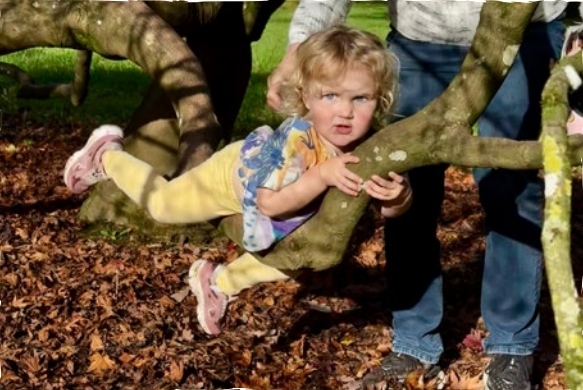
Why then are playing in the mud, climbing trees, making dens, creating models from sticks and leaves, cooking on a fire, and lying under an autumn tree antidotes to this overwhelming feeling of anxiety? The research done by Ellen Sandseter, Swedish early years educator and researcher, into the six risky play types has shown that risky play reduces anxiety and phobias about the world.
These are:
(hide and seek and den making)
(mud kitchen and cooking on fires)
(tree climbing)
(running games in the woods)
(play fighting providing important physical contact and understanding of limits)
(crafting a wooden train, weaving and sewing a puppet).
Experiences such as these are essential to our development - especially in early years, if we are to live in this stressful world with less anxiety. These can happen providing there is an adult holding the safe space, not adulterating children’s play but observing from afar and only responding when invited by the child’s play cues.
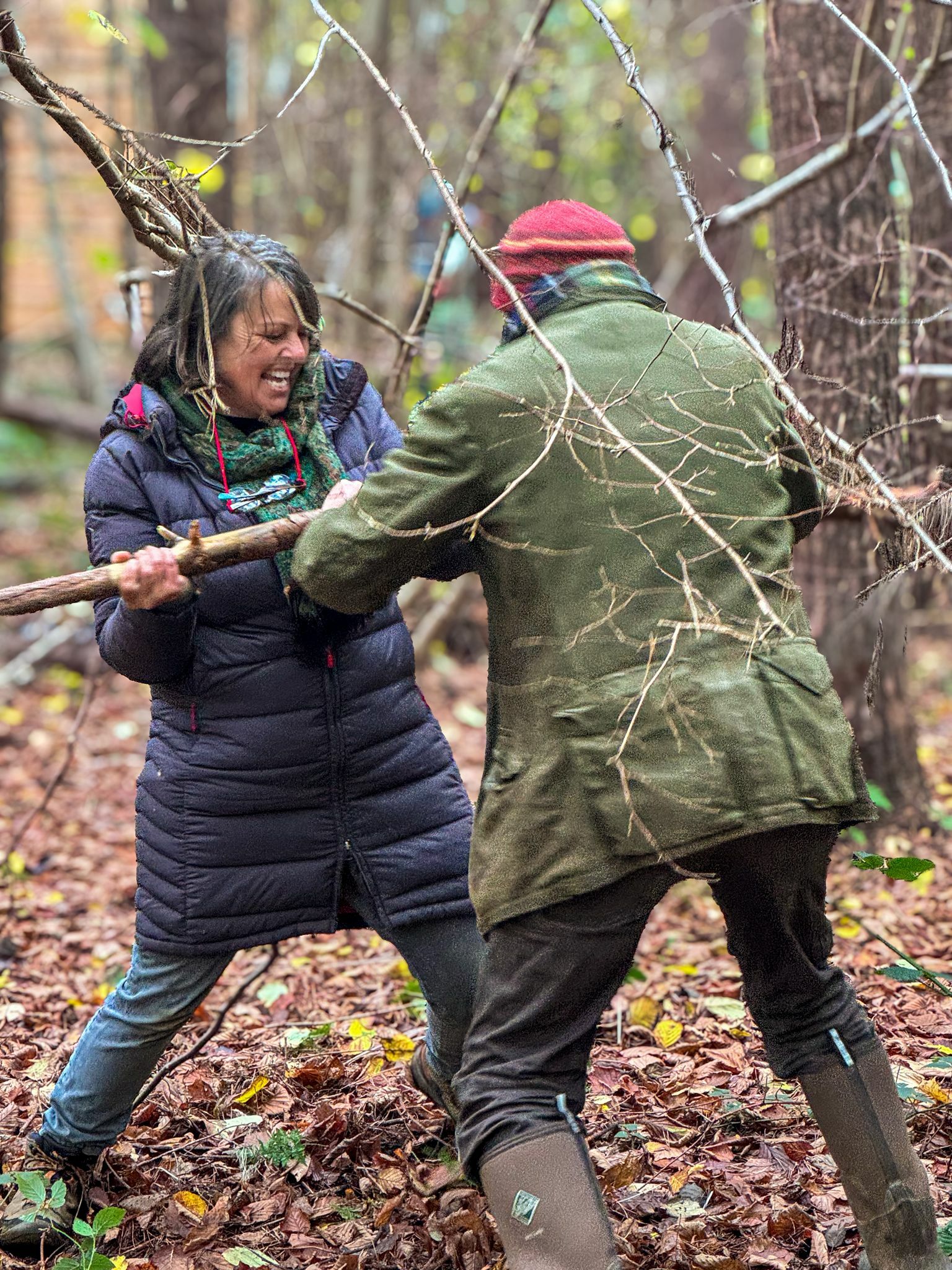
It takes a playful adult who has their own 'bank of play experiences' and 'knowings of the play cycle and the natural world'.
The adult role is to provide a comfortable place and safe person for children to come back to when they need reassurance and the presence of a key adult to return to play. It is not to ask questions or make demands but to share their warm regulated nervous system in co-regulation.
What else are we, the adults, doing? We should be connecting ourselves to the natural tonic of soil, air, clouds, sunshine, leaves dancing and tree waving in our own playful way, so that we are regulated and in the moment, ready to provide that warm safe space for children to lean into when needed. Our role is to let go and trust that the natural world will support all the developmental milestones our small human beings require.
Children need a great deal of free play to thrive in the world. In particular they need ample time in the greatest play place - the natural world outdoors, where senses and the drive to play are most satisfied. Here anxiety is reduced and wellbeing increased.
Jon Cree is an Institute for Earth Education Trainer, Forest School leader and environmental trainer. He now works more and more with anxiety and trauma, running training for numerous settings. As well as providing training he is a director of Bramblewood CiC, and co-authored ‘The Essential Guide to Forest School and Nature Pedagogy’ with Marina Robb.
For more information about Jon’s training keep an eye on his Facebook page.
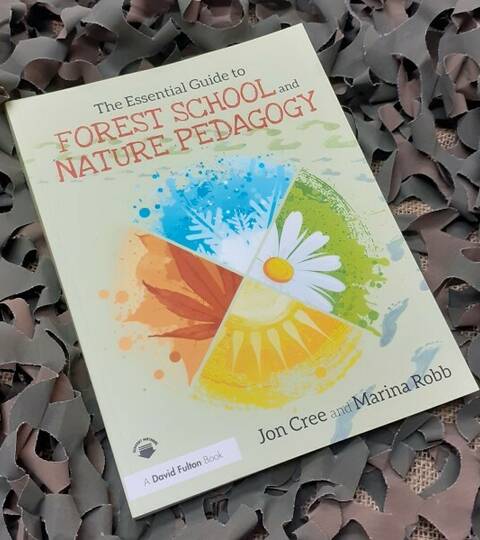
This book is a complete guide to Forest School provision and Nature Pedagogy and it examines the models, methods, worldviews and values that underpin teaching in nature. Jon Cree and Marina Robb show how a robust Nature Pedagogy can support learning, ...

Jon Cree single pages
Nature connection v nature contact article
Is your practice nature connection or nature contact? And does it matter?
Forest School practitioner & trainer Louise Ambrose considers.
From The Outdoor Practitioner magazine, issue 3: Forest School Focus.
Nature connection in the news
Articles, blogs & news items, from the UK & internationally, on the importance of, and barriers to, connecting with nature, for children & adults.
To start, 2 articles from Muddy Faces that first appeared in our Outdoor Practitioner magazine.
Arranged in chronological order, most recent at the top
Nature Connection videos & podcasts
Podcasts & videos from nature experts and outdoor practitioners, discussing the impact of nature deficit and the importance and benefits of nature connection.
Read More about Nature Connection videos & podcasts