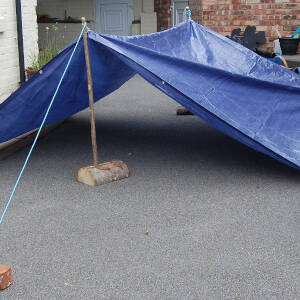
Most woodlands have a good supply of shelter building resources. Learn how to create some basic structures.
Introduction
There are so many ways to create woodland dens it would be impossible to show them all. Here we're offering some examples of centrally-supported shelters which we hope may give you some ideas to get your den building off the ground.
Top tip
If you are confident with tools then using anvil loppers (on deadwood) can be a handy way to cut unwieldy pieces to length if you are making a more precise structure.
Consider the environmental impact of preparing, carrying out & completing this activity. Could this impact be reduced? Specific considerations for this activity could include:
use dead wood
leave no trace
Health & Safety Considerations
Follow your usual operating procedures and carry out appropriate risk benefit assessments. Some considerations particular to this activity include:
support of larger branches
choice of site - avoid ants nests
weather - wind
tool use
Lean to
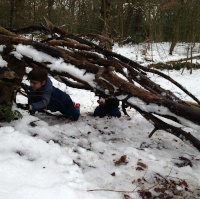
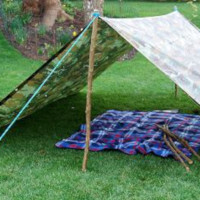
A simple lean to against a tree stump.
This is a really simple and effective way to create a woodland shelter without needing any additional resources like string.
Tripod
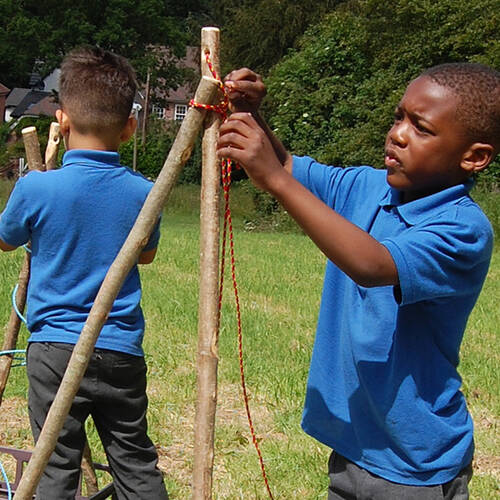
Constructed using two strong sticks tied or balanced together to hold up one end of a central beam, creating an elongated tripod.
Sticks are then laid from the ground onto the central beam.
This creates a shelter that is higher at one end, going down to the ground at the other end.
Tipi shape
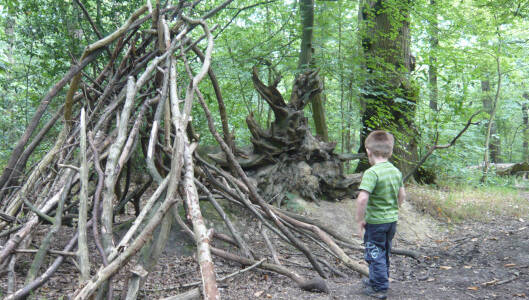
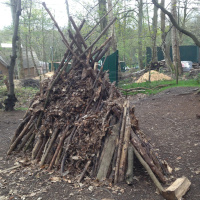
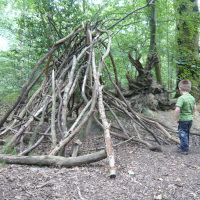
Balance several branches together to create a tipi shape, then continue to add more and more branches.
Use what's there
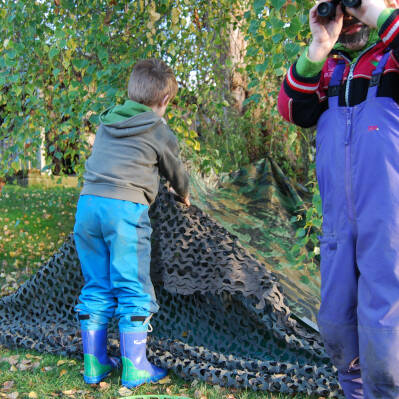
Most shelters can be constructed using just the resources you can find in the woods.
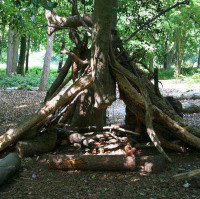
This one is simple but effective – an interesting old tree has been used as a
central support and logs have been leant up against it creating a
circular foot print.
Most shelters can be constructed using just the resources you can find in the woods. Many other different shaped dens can be made, such as benders and stand
alone shelters.
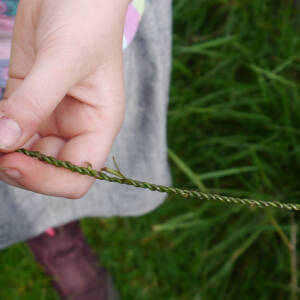
Try braiding bark or use nettle cordage for lashing or bend supple branches or saplings and twist them together.
Take it further
Experiment with other different shaped dens - such as benders and stand alone shelters.
Try braiding bark or use nettle cordage for lashing sticks together, or bend supple branches or saplings and twist them together.
Turn your outdoor space into an active learning environment with loose parts play, den building and block play. Learn how these approaches boost physical activity, support child development, and provide impactful ways to use PE and Sports Premium funding in EYFS and primary schools.
Free to download, created by Muddy Faces. An excellent (though we say so ourselves!) and extensive practical guide to indoor and woodland den building.
Disclaimer: Muddy Faces cannot take any responsibility for accidents or damage that occurs as a result of following this activity.You are responsible for making sure the activity is conducted safely.